Table of Contents
Transforming Forensics from a Cost Center to a Proactive Investment
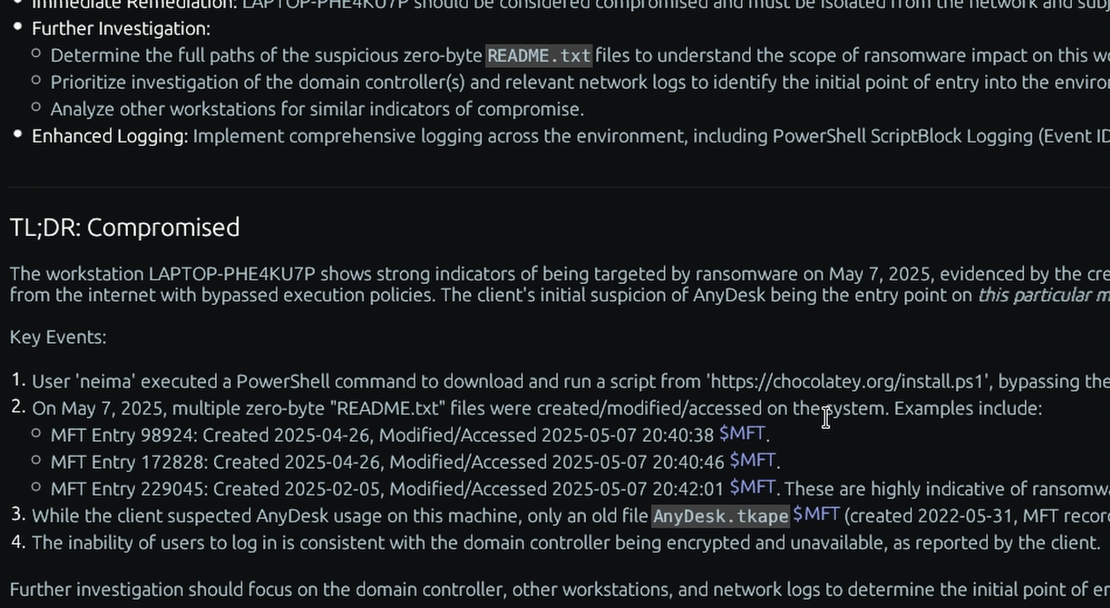
Traditional digital forensics and incident response (DFIR) is an incredibly manual, slow, and expensive “autopsy” process. When deployed reactively, highly-paid analysts spend hundreds of hours manually acquiring and parsing artifacts like the $MFT, Amcache.hve, and EVTX logs.
TensorGuard operationalizes this process, deploying AI to automate the aggregation and contextualization of these artifacts at fleet-wide scale. The result is an unprecedented economic shift in security operations.
The High-Impact Payoff
TensorGuard delivers value by drastically cutting operational expenses and reducing catastrophic financial risk. By automating collection and analysis, organizations see an immediate 94%+ cost reduction compared to traditional manual DFIR retainers.
1. The Economics of Automation
Assuming a conservative manual DFIR blended rate of $500–$700/hour (inclusive of administration, tooling, reporting, and overhead), traditional triage quickly becomes cost-prohibitive at scale. TensorGuard changes the financial equation by moving from an hourly services model to an automated software model. Our customers usually see over 94% savings in comparative costs.
| Metric | Manual DFIR Approach | TensorGuard Automated Assessment | Impact |
|---|---|---|---|
| Time per Endpoint | 2-4 Hours | Seconds | Eliminates analyst fatigue |
| Fleet-Wide Triage | Weeks to Months | Under 10 Minutes | Real-time situational awareness |
| Cost Structure | Uncapped Hourly Retainers | Predictable Flat Licensing | > 94% Capital Savings |
2. Time-to-Certainty at Scale
While a 1,000-endpoint engagement is largely impossible for human-led investigations due to time constraints, this scale becomes a reality with TensorGuard’s parallel analysis architecture.
- Human-Led Triage: 2 to 4 hours per endpoint. For 1,000 endpoints, this equals 2,000–4,000 analyst hours. With a dedicated team of 5 analysts, this process requires 10 to 20 calendar weeks just to establish an initial triage baseline.
- TensorGuard Analysis: Once artifacts are ingested, the contextual AI engine correlates the data for 1,000 endpoints in under 10 minutes.
This operational velocity acts as a profound force multiplier. Instead of multi-week uncertainty, your security team receives same-meeting answers on exactly where to focus their deep-dive human remediation efforts.
3. Breach-Avoidance Economics
Industry studies place the average U.S. data breach cost at approximately $10.22M. By proactively scheduling recurring fleet-wide checks, TensorGuard identifies dormant threats and historical persistence mechanisms before they escalate into catastrophic incidents.
- The Break-Even Probability: A proactive TensorGuard Compromise Assessment breaks even if it reduces the probability or scale of a US-average breach by less than a fraction of a percent.
- The ROI Multiple: Successfully avoiding one average US breach via a proactive assessment represents an 852x ROI.