Table of Contents
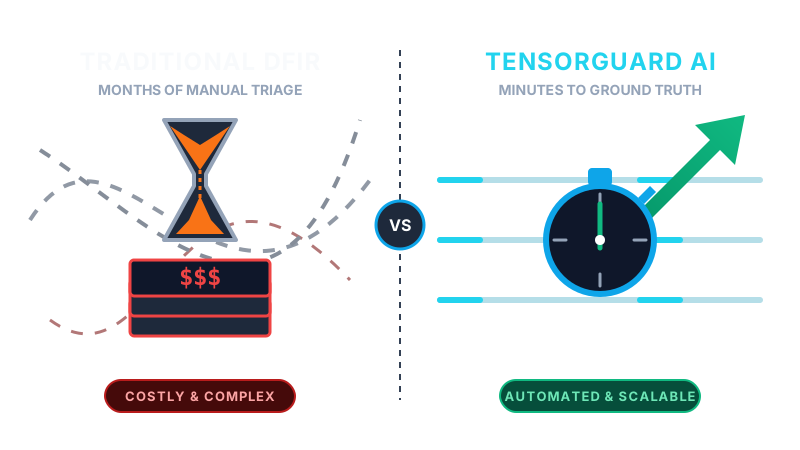
For the last two decades, incident response economics have remained stubbornly archaic. When a security breach is suspected, organizations traditionally activate an uncapped incident response retainer. Elite consultants from legacy firms are parachuted into the environment, billing blended rates upwards of $700 per hour to manually acquire disk images, format .evtx logs, and parse the $MFT.
While top-tier IR firms provide undeniable value during the negotiation and remediation phases of a catastrophic breach, paying elite hourly rates to manually parse forensic data at a fleet-wide scale is no longer economically justifiable. Organizations are increasingly seeking Mandiant alternatives that do not require blank checks for basic triage.
TensorGuard fundamentally disrupts this model. By operationalizing digital forensics, we automate the triage phase, saving human expertise for targeted remediation and transforming an automated compromise assessment from an unpredictable cost center into a proactive, high-ROI security investment.
The Mathematical Reality of Fleet-Wide Triage
To understand the scale of this economic shift and the importance of reducing DFIR costs, we must look at the time-to-certainty required to establish a baseline of compromise across an enterprise.
A highly skilled human analyst requires an average of 2 to 4 hours to manually extract, parse, and correlate the forensic artifacts on a single endpoint.
Human-Led Triage vs. TensorGuard Parallel Analysis
- Human-Led Triage: For a mid-sized organization assessing 1,000 endpoints, manual triage consumes 2,000 to 4,000 analyst hours. Even with a dedicated team of five full-time investigators, an initial assessment requires 10 to 20 calendar weeks.
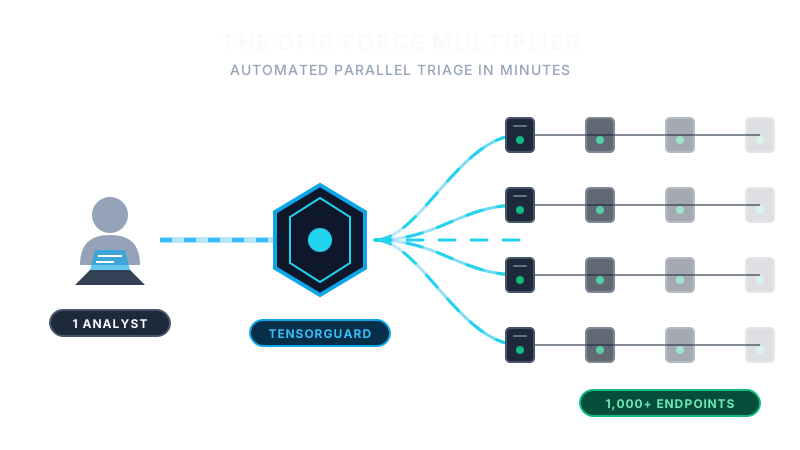
- TensorGuard Parallel Analysis: Through state-of-the-art large data processing methods and our Evie 2.0 Intelligence Engine, TensorGuard automatically parses and contextualizes the exact same forensic artifacts across 1,000 endpoints, in as little as 10 minutes.
The Economic Shift: Achieving 90%+ Capital Savings
This operational velocity acts as a profound force multiplier, slashing exorbitant incident response retainer costs.
Consider a standard 50-device “Department Sweep” following a suspected phishing incident. Under the traditional manual model, evaluating 50 endpoints at a conservative 3 hours per device equates to 150 analyst hours. At standard industry blended rates, this manual triage phase alone costs an organization upwards of $100,000.
With TensorGuard, this exact same Department Sweep is executed for a predictable, flat fee. This represents an immediate 90%++ capital savings compared to traditional manual triage, delivering definitive answers in a fraction of the time without the need for an uncapped retainer.
A Force Multiplier, Not a Replacement
TensorGuard doesn’t exist to eliminate elite IR consultants; it exists to optimize them. Automate the vast, tedious triage phase with TensorGuard, and reserve your expensive human expertise strictly for targeted remediation and strategic incident command.
Intelligence, Not Just Billable Hours
Raw forensic data is overwhelmingly voluminous. Paying an external consultant hundreds of dollars an hour to translate raw CSV data into a document is highly inefficient.
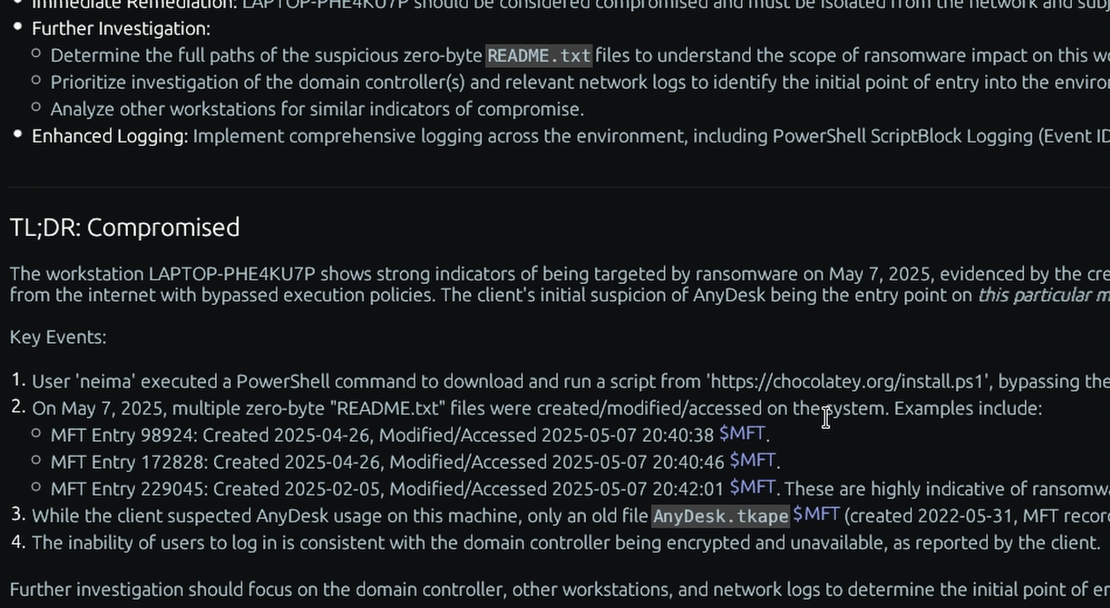
TensorGuard’s AI-powered reporting automatically synthesizes these artifacts into clear, actionable intelligence. Stakeholders receive C-Suite-ready executive summaries, precise Indicators of Compromise (IoC) timelines, and step-by-step remediation advice. Crucially, every AI-generated claim is directly linked to the underlying raw forensic evidence, ensuring verifiable, defensible proof that can be handed directly to internal counsel or external IR teams if a breach is confirmed.
Stop paying hourly rates for data formatting. Automate the autopsy, and invest your security budget in proactive resilience.